
Qualified procedures
Qualified welding procedures (WPS).
Service 10 / 14
Fabrication and assembly of metal structures and pressure vessels, welding of pipes and equipment, and repair and maintenance of components. Pressure vessels are designed, fabricated and certified under the applicable section of the ASME Code, with high quality and compliance with technical standards.

Fabrication and assembly of metal structures and pressure vessels, welding of pipes and equipment, and repair and maintenance of components.
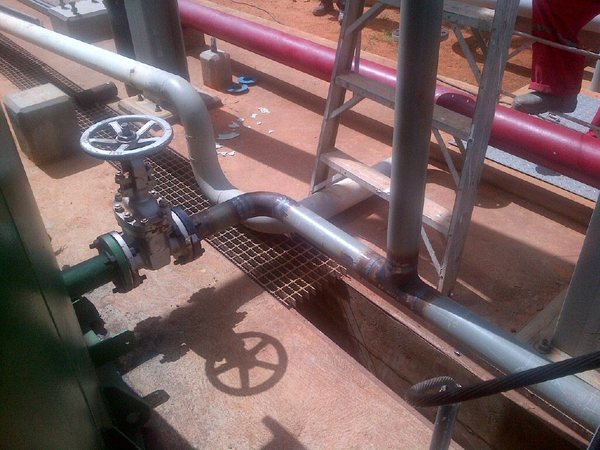
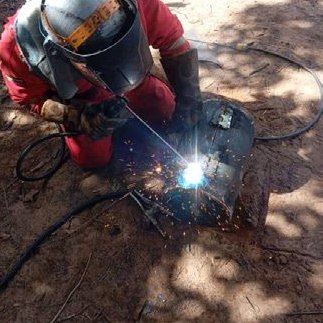
In the oil and energy industry, welding is applied to pipelines, pressure vessels, metal structures and critical components. A formal welding service includes:
Qualified welding procedures (WPS).
Welders qualified for each process and material.
Inspection with non-destructive testing.
Documentation with complete traceability of the process.
Why it matters: weld quality determines the integrity of the joint, which is why it is verified through inspection and documented.
The process is chosen according to the material, the thickness, the welding position and the quality the specification requires. The processes used are:
Arc welding with a non-consumable tungsten electrode and an inert shielding gas. It gives clean, precise welds and is typical for root passes in piping, thin walls and stainless steel.
Arc welding with a continuously fed wire electrode and shielding gas. High deposition rate, suited to structures, plate and long runs of fabrication work.
Welding and cutting with a flame of fuel gas and oxygen. Widely used for cutting plate and profiles, for heating and for light repairs.
Joins metals with a filler metal that melts above 450 °C but below the melting point of the base metal, which does not melt.
Same principle with a filler metal that melts below 450 °C. Used in low-stress joints and in small connections.
Work carried out in the shop and in the field:
A pressure vessel is a closed container that holds a fluid at a pressure different from the atmospheric one: separators, scrubbers, accumulators, air receivers, filters and the shells of heat exchangers. Because a failure releases the energy stored in it, its design, its materials, its welds and its tests follow a code.
Pressure vessels are designed, fabricated and certified under the applicable section of the ASME Boiler and Pressure Vessel Code.
Calculation of thicknesses, heads, nozzles and supports for the design pressure and temperature, with the corrosion allowance.
Plates, forgings, pipe and fittings of the grades the code allows, with their certificates and traceability.
Cutting, rolling and fit-up; welding with qualified procedures and qualified welders; heat treatment when the code requires it.
Non-destructive examination of the welds to the extent the design requires.
Hydrostatic test of the finished vessel, above its design pressure.
Data report signed after the inspection, and nameplate with the design data of the vessel.
Review of the drawings, the specifications and the applicable standards, and definition of procedures and inspection points.
Receipt of material with its certificates and identification, so that every piece can be traced.
Cutting, beveling and alignment of the parts, held in place with tack welds.
Welding under the qualified procedure, by qualified welders, with control of the welding parameters.
Visual inspection, non-destructive testing and, where applicable, pressure testing.
Dimensional check, cleaning and, when required, coating; final dossier with procedures, qualifications, inspection reports and traceability.
Weld quality is verified without damaging the part. The usual methods are:
The first and most basic check: weld profile, dimensions and surface defects.
Reveals cracks and pores open to the surface in non-porous materials.
Detects surface and near-surface discontinuities in ferromagnetic materials.
Uses sound waves to find internal flaws and to measure thickness.
Uses X-rays or gamma rays to obtain an image of the inside of the weld.
Hydrostatic or pneumatic test to verify the strength and tightness of piping and equipment.
Typical interventions on equipment that is already in service:
Reference standards commonly applied in the sector. They are listed for orientation and do not replace the specification of each project.
Request a quote
Tell us what you need and our technical team will prepare a proposal for you.