
Manual
Personnel inside the tank, with greater exposure to confined spaces.
Service 05 / 14
Industrial mechanical cleaning, inspection and rehabilitation of tanks, with protection against corrosion and lightning, carried out as a single multidisciplinary project from the moment the tank leaves service until it returns to operation. The service also covers separators, furnaces and boilers, heat exchangers and rotating equipment.

A major maintenance takes an asset out of service to return it to its design condition. For a storage tank, that means emptying, cleaning, inspecting, repairing and protecting it, so that it goes back into operation with its structural integrity, its measurement systems and its corrosion protection restored.
The service brings together tank cleaning and tank rehabilitation in a single multidisciplinary effort, so that every discipline works toward the full operational recovery of the tank.
At the bottom of oil tanks, sediments, water, heavy hydrocarbons, scale and rust settle and form sludge. Part of that material can be recovered as product; the rest is waste and must be handled as such.
Review of the tank history and previous inspections; scope, schedule, materials and safety plan.
The tank is emptied and isolated: lines blinded or disconnected and energy sources locked out.
Removal of the remaining product and sludge, and ventilation until the atmosphere is safe.
The condition of the floor, shell, roof, foundation and accessories is assessed, and the repairs are defined.
Civil, mechanical, electrical and instrumentation works, according to the diagnosis.
Surface preparation and application of the coating system, inside and outside.
Inspection of the repairs, tightness tests and verification of the instruments and of the cathodic protection.
Final documentation and handover of the tank to operations.
Using explosion-proof equipment, with grounding of equipment and hoses.
With spark-proof tools.
Forced ventilation until a detector verifies that the atmosphere is not explosive (0% LEL).
Personnel entry for mechanical and manual cleaning and removal of sludge and sediment from the bottom.
Personnel inside the tank, with greater exposure to confined spaces.
Removes sludge without direct handling.
Less entry of people into the tank interior.
Removes hardened deposits from the floor and the walls.
Separation of recoverable hydrocarbon, water and solid waste.
Recovery of the hydrocarbon that can return to the process.
Storage in suitable containers and transport by authorized vehicles.
Treatment and final disposal in accordance with the applicable environmental regulations, with records of each step.
A clean tank makes the internal inspection possible. Its findings define the scope of the rehabilitation:
The work is organized in four disciplines that run together as one project:
Repair and sanitation of the structural bases, the foundation and the containment and drainage of the tank.
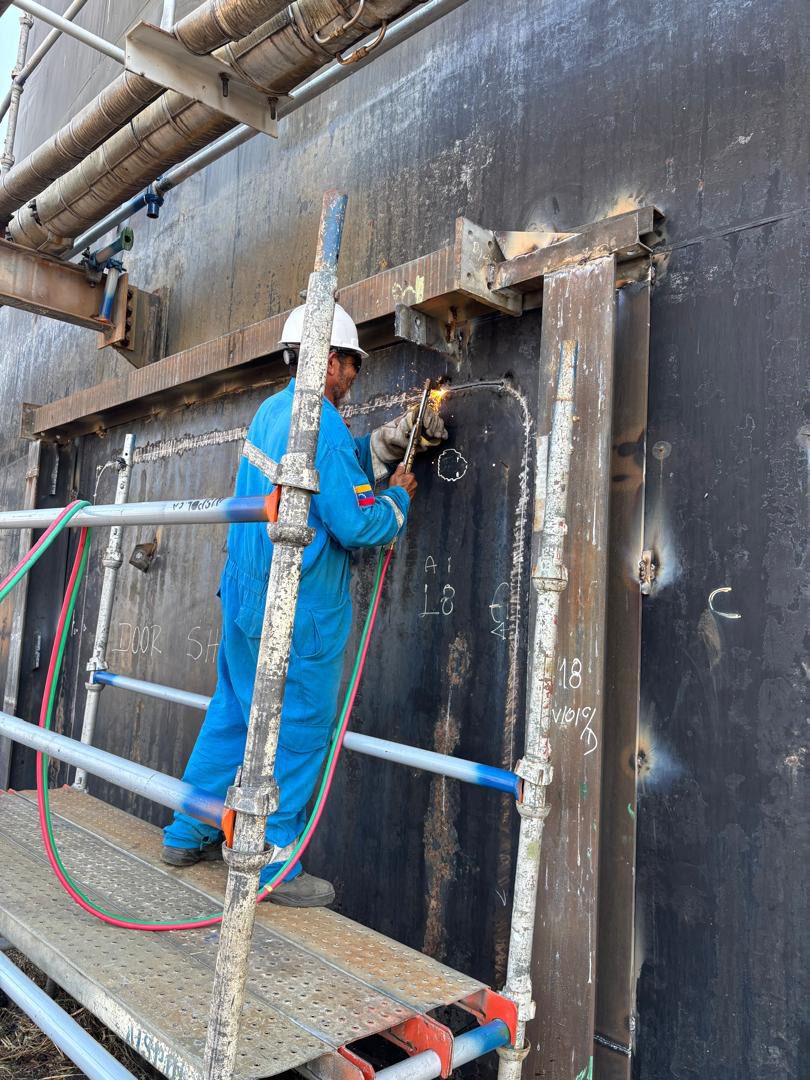
Replacement of plates in the floor, the shell and the roof, welding, nozzles and accessories, with specialized scaffolding for work at height.
Grounding, electrical installations, the cathodic protection system that protects the floor against corrosion, and the protection of the tank against lightning.
Level measurement systems and their instruments, to recover the accuracy of the measurement.
A tank that stores flammable liquids is exposed to lightning: a direct strike, or the currents that a nearby strike induces, can produce a spark where there are vapors, typically at the rim seal of a floating roof or at the vents. The protection gives that current a continuous, low-resistance path to ground, so that it does not jump across a gap.
A plant shutdown is the planned window in which a facility stops to inspect, repair and replace what cannot be touched while it operates. The major maintenance of tanks is usually scheduled within that window, and the same stop is used for the rest of the static and rotating equipment.
Opening and cleaning, inspection of the shell and the internals, repair or replacement of internals, coating, and testing of safety valves and instruments.
Inspection and replacement of tubes, repair of refractory and insulation, burners, cleaning of soot and scale, hydrostatic test, and controls and safeties.
Pulling of the bundle, cleaning of tubes and shell, plugging or replacement of tubes, new gaskets and hydrostatic test.
Pumps, compressors, turbines and motor-generators: overhaul, replacement of seals and bearings, alignment, balancing and vibration analysis.
List of jobs for each piece of equipment, defined and closed in advance.
Materials, spares, tools, scaffolding and personnel on site before the plant stops.
Equipment emptied, cleaned, blinded and locked out, with its work permits.
Work by fronts and shifts, with daily follow-up of the schedule and of the findings.
Inspection, pressure tests, alignment and loop checks; start-up and handover to operations.
Degassing is the highest-risk stage. Safety perimeters are established, certified equipment for explosive atmospheres is used, and a procedure is required for:
Reference standards commonly applied in the sector. They are listed for orientation and do not replace the specification of each project.
Request a quote
Tell us what you need and our technical team will prepare a proposal for you.