Service 01 / 14

Well Rehabilitation & Maintenance

Rehabilitation and maintenance of oil and gas wells through five lines of work: workover, coiled tubing, slickline, electric wireline and well testing. Together they make it possible to diagnose a well, correct what limits it and return it to production.

Drilling rig mast seen across a field at dusk
  • 5lines of service
  • 2ways to intervene a well: with and without a rig

The service

Few wells produce without interruption from the first day until their abandonment. Equipment wears out, tubing leaks, sand, scale or paraffin build up, and the conditions of the reservoir change. Well rehabilitation and maintenance brings together the operations that diagnose those problems and correct them, to recover production and keep the well safe.

Five lines of service

Workover

Major intervention with a rig to repair or replace the completion of the well.

Coiled tubing

Continuous pipe run into the live well to circulate, clean out, stimulate and mill, without a rig.

Slickline

Mechanical work inside the well with a steel wire, without killing the well.

Electric wireline

Logging, perforating and setting of tools with a conductor cable and real-time data.

Well testing

Measures what the well produces and how the reservoir responds.
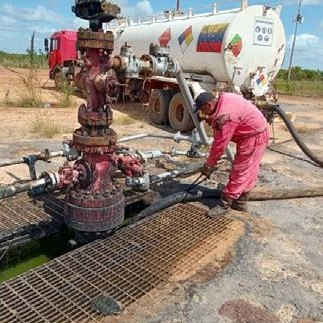
Work at a wellhead with a tank truck, Campo Melones, Orinoco Oil Belt (Tanzaca project).

Workover

A workover is a major intervention: the well is killed with fluid, the wellhead tree is removed, blowout preventers are installed and the production tubing and the completion are pulled out with a rig. It is used when the problem cannot be solved through the tubing.

Common reasons for a workover

  • Replace corroded or leaking tubing
  • Repair or replace the artificial lift system: pumps, rods or gas lift mandrels
  • Repair casing leaks or isolate zones with remedial cementing
  • Clean out sand or fill and install sand control
  • Recomplete the well: close a depleted interval and open a new one
  • Recover stuck equipment (fishing)
  • Convert a producer into an injector, or abandon the well safely

Typical sequence

  1. Diagnosis and program

    Review of the well history, tests and logs; work program with objectives, fluids, equipment and risks.

  2. Rig move and rig-up

    Preparation of the location, move of the rig and its auxiliary equipment, and rig-up.

  3. Well kill and blowout preventers

    The well is controlled with kill fluid, the tree is removed and the blowout preventers are installed and tested.

  4. Pulling the completion

    Tubing, rods, pump and downhole equipment are pulled out and inspected.

  5. Downhole work

    Cleanout, repairs, cementing, perforating, stimulation or recompletion, according to the program.

  6. New completion

    The completion and the lift system are run in; the wellhead is installed and tested.

  7. Return to production

    The well is put back on production and tested to confirm the result.

Coiled tubing

Coiled tubing is a continuous length of steel pipe, wound on a reel, that an injector head pushes into the well through the production tubing. It works with the well under pressure and, unlike a wire, it lets fluids be pumped through it at any moment. It sits between wireline and a workover: it does what a wire cannot do, without bringing in a rig or pulling the completion.

Typical operations

  • Cleanout of sand, fill and scale by circulation
  • Nitrogen lift to unload the well and bring it back on production
  • Matrix stimulation: placing acid and other treatments at the exact interval
  • Cement squeezes and plugs placed through the tubing
  • Milling of plugs, scale and obstructions with a downhole motor
  • Fishing and running of tools in deviated and horizontal wells, where a wire does not reach by gravity

Slickline

Slickline is a single strand of steel wire, without electrical conductors, that runs tools in and out of the well from a winch unit. It works with the well under pressure, so production is interrupted only briefly, and it is the quickest and most economical way of doing mechanical work downhole.

Typical operations

  • Gauge runs to verify the inside diameter of the tubing and tag the top of sand or fill
  • Setting and retrieving plugs, chokes and subsurface safety valves
  • Opening and closing sliding sleeves
  • Changing gas lift valves
  • Running memory gauges to record downhole pressure and temperature
  • Cutting paraffin and removing scale or sand
  • Light fishing of wire and tools

Electric wireline

Electric wireline uses a cable with electrical conductors that powers the downhole tools and sends their readings to surface in real time. It is used when the job needs measurements, depth precision or electrical activation.

Typical operations

  • Depth correlation with gamma ray and casing collar locator (CCL)
  • Cement bond logs to evaluate the cement behind the casing
  • Production logs to identify which intervals contribute oil, gas or water
  • Caliper and corrosion logs to inspect tubing and casing
  • Perforating and re-perforating of producing intervals
  • Setting bridge plugs, packers and cement retainers
  • Pipe recovery: free-point determination and tubing cutters

Well testing

A well test is a planned set of measurements that shows how much oil, gas and water a well produces and at what pressures. It is the basis for deciding whether a well needs an intervention and for checking, afterwards, whether the intervention worked.

What is measured

  • Flow rates of oil, gas and water
  • Pressure and temperature at the wellhead and downhole
  • Gas–oil ratio (GOR) and water cut
  • Fluid samples for laboratory analysis
  • Pressure build-up and drawdown behavior

Typical surface equipment

  • Choke manifold to control the flow
  • Test separator with a meter for each phase
  • Gauge tanks and transfer pumps
  • Surface safety valve and emergency shutdown system
  • Data acquisition system

Choosing the intervention

Without a rig: coiled tubing, slickline and electric wireline

  • The well stays under pressure; it is not killed
  • Compact unit and a small crew
  • Work is done through the production tubing
  • Wireline: diagnosis and mechanical changes
  • Coiled tubing: jobs that need circulation, such as cleanouts, stimulation and milling

With a rig: workover

  • The well is killed and the completion is pulled out
  • Rig, auxiliary equipment and a larger crew
  • Gives access to the whole well
  • Suited to tubing, artificial lift, casing and changes of zone

The usual path goes from the least to the most invasive: test the well, diagnose with slickline or electric wireline, solve with coiled tubing what can be solved through the tubing, and go to a workover only when the problem requires it. Each decision weighs the cost of the intervention against the production it is expected to recover.

Safety and well control

  • Well barriers verified and pressure-tested before any work begins
  • Pressure control equipment tested before each job
  • Work permits, job safety analysis and pre-job meetings
  • Gas detection at the location: hydrogen sulfide and explosive atmospheres
  • Specific procedures for handling explosives in perforating jobs
  • Containment and handling of the fluids recovered from the well
  • Emergency response plan and well control drills

Reference standards

Reference standards commonly applied in the sector. They are listed for orientation and do not replace the specification of each project.

API RP 54
Occupational safety and health for oil and gas well drilling and servicing operations.
API Spec 6A
Wellhead and tree equipment.
API Std 53
Well control equipment systems.
API RP 5C7
Coiled tubing operations in oil and gas well services.
API RP 16ST
Coiled tubing well control equipment systems.
API RP 19B
Evaluation of well perforators.
API RP 67
Oilfield explosives safety.

Request a quote

Need this service for your operation?

Tell us what you need and our technical team will prepare a proposal for you.